
Have you ever asked yourself if it's really worth spending extra money on mining machines? Here, we break it down by looking at key factors like hash rate (which tells you how fast the machine works), power use, and cooling systems that keep things running smoothly. We'll take a close look at popular choices such as the S21 Hyd and the M56S, sharing the details that matter most for both beginners and seasoned miners. By comparing how well they perform against their price, we reveal which options offer the best value for Bitcoin mining in 2025. So, stay with us as we explore the top picks to boost your mining setup.
Top Bitcoin Mining Hardware Reviews for 2025: Performance and Pricing
When you're picking out a Bitcoin miner, it's smart to look at things like hash rate (how quickly a miner can solve puzzles and earn rewards), power use, and cooling systems. A higher hash rate gives you a better shot at earning more, while lower power consumption helps cut down on running costs. And keeping the miner cool is key, using water or hydro cooling can really help keep temperatures steady and extend the life of the machine. Ever notice how a calm, stable temperature can make a big difference?
| Model | Hash Rate (TH/s) | Power (W) | Efficiency (J/TH) | Cooling | Price (USD) |
|---|---|---|---|---|---|
| S21 Hyd | 355 | , | , | Hydro | ≈$7,800 |
| S19 XP Hyd | 255 | , | , | Hydro | , |
| A1366 | , | , | , | Air (6 fans) | , |
| M50S | 126 | 3,276 | , | Air | , |
| M56S | 212 | 5,550 | , | Water | , |
Budget models generally aim for a lower upfront cost while still offering enough performance for beginners. On the other hand, high-end miners might be pricier, but they deliver stronger hash rates and come with advanced cooling systems that keep everything running smoothly. If you’re ready to invest a bit more from the start, you could save on power costs over time while boosting your processing power. At the end of the day, whether you choose a budget-friendly option to test the waters or a top-tier miner for long-term gains, there’s a model designed to fit your needs.
bitcoin mining hardware reviews: Stellar Choices
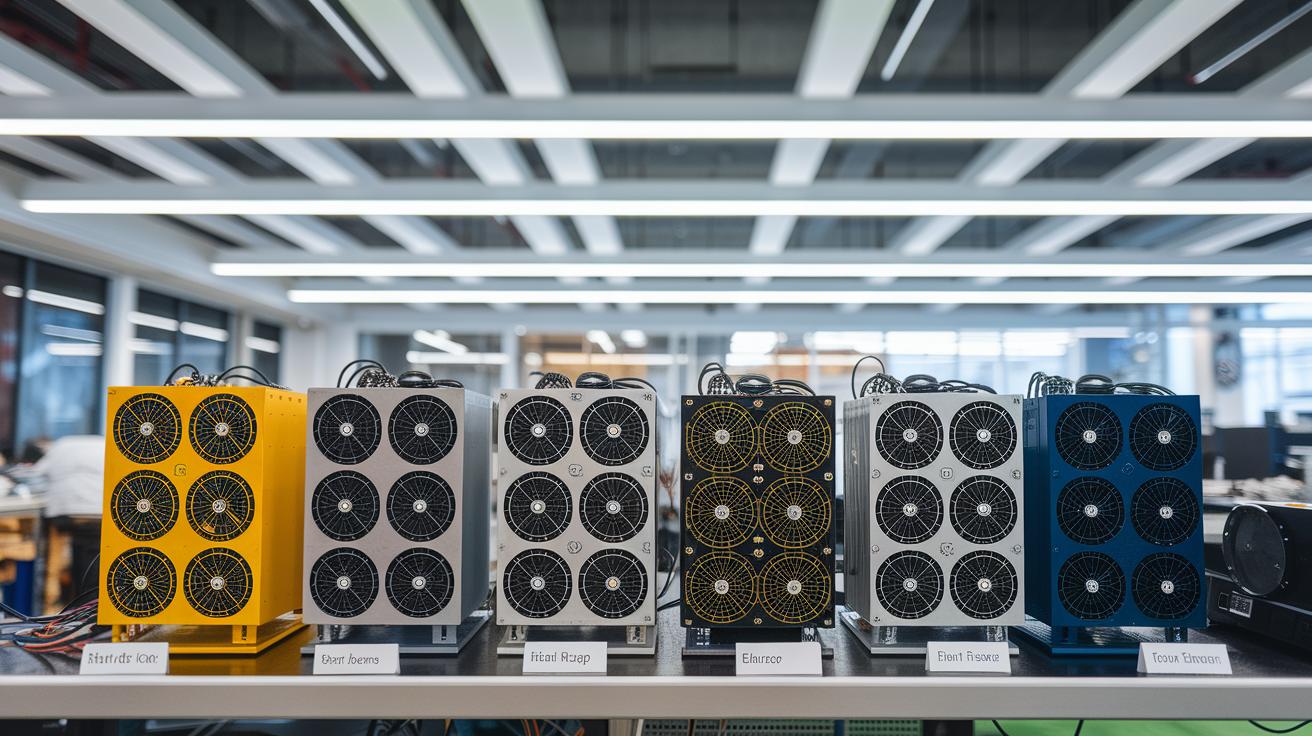
When you're picking a mining rig, it helps to compare its hash-rate (how quickly it solves puzzles to earn coins) with its watt consumption (how much energy it uses). Simply put, you want a machine that works hard without eating up your power bill.
Pros:
- Antminer S21e XP Hyd 3U: This model pushes an impressive 860 TH/s and only uses 13 joules per terahash (J/TH), and while it runs at a moderate 50 decibels of noise, it's perfect when you need top-notch performance.
- Antminer S21 XP+ Hyd: With a solid 500 TH/s and a neat 11 J/TH, it runs at about 5,500 watts. It’s a reliable choice if you want performance without too much power draw.
- Auradine Teraflux AH3880: This miner hits 600 TH/s and runs quietly at 35 decibels. Plus, its price tag of $7,800 makes it a friendly option for those watching their budget.
- Bitdeer SealMiner A2 Pro Hyd: Offering 500 TH/s at around 7,450 watts, it comes with a standout price of $3,958, an attractive pick if you want to save on upfront costs.
Cons:
- Antminer S21e XP Hyd 3U: The higher price of $17,000 might be a drawback for smaller setups.
- Antminer S21 XP+ Hyd: Its lower hash rate compared to the top model may slow things down during heavy tasks.
- Auradine Teraflux AH3880: Its energy efficiency value isn’t the best, which might chip away at power savings over time.
- Bitdeer SealMiner A2 Pro Hyd: While its price is low, it might not keep up as the demands grow, especially for larger enterprises.
For businesses that need constant, strong performance, the Antminer S21e XP Hyd 3U stands out despite its higher cost. On the other hand, mid-sized operations might prefer the nice balance of efficiency and price offered by the Auradine Teraflux AH3880 or Bitdeer SealMiner A2 Pro Hyd.
Cryptocurrency Equipment Assessment: Noise Levels and Cooling Solutions
Keeping your mining rig cool is super important. When a rig gets too hot, it doesn’t perform as well and its parts can wear out faster. A good cooling system helps the machine run at its best and saves you money by wasting less power.
Noise is another key factor. If you’re using a miner at home, you want it to be as quiet as possible. Data centers, however, can handle a bit more noise. For instance, the Goldshell AE Max can reach up to 85 dB. That level of sound might work in a busy data center, but it could be a real distraction at home.
Different cooling methods offer their own perks. Air-cooled systems, like the Avalon A1366 with its multiple fans, do a great job of keeping things cool. On the other hand, rigs like the WhatsMiner M56S use water cooling, which only makes about 45 to 50 dB of sound. This quieter option is perfect if you need a low-noise setup.
Comparing Bitcoin Mining Hardware Performance Benchmarks

When we test mining hardware, we use standardized methods so every device is measured fairly. This means looking at each rig's hash rate, which tells you how many calculations it can perform per second, and its power consumption. In simple terms, it helps us see which miner gives you more work done for every watt of power used.
| Device | Hash Rate | Power Consumption |
|---|---|---|
| WhatsMiner M30S++ | 112 TH/s | N/A |
| WhatsMiner M50S | 126 TH/s | 3,276 W |
| WhatsMiner M56S | 212 TH/s | 5,550 W |
| AvalonMiner 1246 | 90 TH/s | N/A |
| Dragonmint T1 | 16 TH/s | N/A |
| Ebang Ebit E11++ | 44 TH/s | 1,980 W |
By crunching these numbers, we get a clear look at each machine's energy efficiency. Ever ask yourself, “How many terahashes per watt is my miner offering?” For example, the M50S produces about 0.0385 TH/s per watt (126 TH/s divided by 3,276 W). Meanwhile, the M56S delivers roughly 0.0382 TH/s per watt (212 TH/s divided by 5,550 W). The Ebang Ebit E11++ trails behind at around 0.0222 TH/s per watt.
These figures show that the M50S and M56S strike a good balance between power and energy use, a key insight for anyone navigating today’s digital asset processing market.
Bitcoin Mining Hardware Cost Analysis and ROI Considerations
When you dive into Bitcoin mining, the cost of your hardware is just the tip of the iceberg. High-end mining rigs can draw anywhere between 1,500 and 5,550 watts. This means that besides the initial price of the machine, you also have to think about power bills and cooling costs. For example, if your rig uses 3,276 watts, you might end up paying between 3 and 10 cents for each terahash (a measure of mining power). Keeping an eye on these numbers is important to balance how well your machine performs against its energy needs.
It’s also important to figure out how long it will take to earn back your investment. Many miners see a return on investment in about 6 to 18 months. To get a clear picture, consider the current Bitcoin price, how challenging mining is right now (mining difficulty), and the cost of electricity in your area. Online calculators can help simplify this process. For instance, if your energy cost is around 4 cents per terahash, a rise in Bitcoin’s price could get you to break even even sooner. Ultimately, paying close attention to power use and energy costs is key when planning your mining setup.
Choosing the Right Bitcoin Mining Hardware: Expert Recommendations

For beginners, mid-tier rigs like the Antminer S19 Pro and WhatsMiner M30S++ offer a fantastic blend of simplicity and efficiency. They deliver steady performance without a complicated setup, kind of like putting together your favorite toolkit with clear, easy-to-follow instructions. Seriously, setting one up is as simple as plugging in a few cables and hitting start.
If you’re planning a home mining setup, you’ll want equipment that keeps things quiet and doesn’t gobble up too much power. Options such as the Avalon6 and the water-cooled M56S are built to run softly, making them perfect for a residential space. Imagine a device that hums gently in the background, much like a refrigerator working away without disturbing your peace.
For larger, industrial-scale mining, you need machines that can handle heavy workloads and grow with your operation. Industrial rigs like the S21e XP Hyd and S21 XP+ Hyd are designed for maximum output and smooth integration into large mining farms. Think of it like having a well-oiled machine that seamlessly fits into your network, managing huge amounts of data effortlessly while keeping energy bills in check.
Maintaining and Upgrading Bitcoin Mining Hardware for Longevity
Taking care of your Bitcoin mining hardware is like giving your trusty computer a regular checkup. Every three to six months, spend a little time cleaning off the fans and heat sinks. Think of it as clearing out a dusty room to help everything breathe easier. When we talk about fans and heat sinks, they’re parts that keep your device cool by moving warm air away, sort of like a natural breeze on a hot day.
It’s important to patch the firmware as soon as updates are released. Firmware, which is the basic software that runs your hardware (imagine it as the engine’s manual for your computer), gets better and safer with each update. Keeping these current means your miner always runs at its best.
Keeping an eye on temperature logs is a smart move too. Monitoring these logs is like keeping an eye on your car’s engine temperature, you catch problems early before they become costly repairs. If you notice your hardware running hotter than usual, it might be a sign to step in and fix the issue.
As your mining equipment ages, you might see it slowing down or heating up unexpectedly. That’s a clue that some parts, like older chips, might need swapping out or that your cooling system could use an upgrade. Other helpful tips include refreshing your thermal paste annually, a substance that helps transfer heat away from your chips, and checking if your power supplies or coolant systems need an update. Planning to integrate next-generation miners now can also set you up for a resilient system in the future.
Final Words
In the action of exploring top bitcoin mining hardware reviews, we compared performance metrics, cooling solutions, and energy consumption. We outlined how high-end rigs deliver powerful performance while more affordable options fit smaller setups. Short overviews of noise levels, maintenance practices, and cost trade-offs helped spark clarity. Each segment offered clear guidance on balancing budget with performance, making the intricate details accessible and practical. Keep these insights in mind to confidently choose a setup that fits your needs and fuel your investment journey.


