
Have you ever wondered how a Bitcoin miner’s hash rate can influence your investment choices? Today’s mining companies are pushing their limits with top-notch machines and smart energy strategies. When Marathon Digital Holdings reaches 29.9 EH/s, it’s not just a number, it shows they’re leading the market.
In this post, we take a friendly look at the strength of the best miners, sharing the unique ways each one operates and innovates. Curious to see how solid data and real performance create opportunity in Bitcoin mining? Let’s dive in and discover which companies are really setting the pace.
Ranking the Top Bitcoin Mining Companies by Hash Rate
Before the Bitcoin boom, small miners often struggled with soaring electricity bills, a stark contrast to today’s industrial-scale operations. In today's market, numbers really speak volumes. Hash rate, which measures how fast mining machines work, is a key signal for anyone looking into Bitcoin mining.
Marathon Digital Holdings leads the pack with a hash rate of 29.9 EH/s. (EH/s stands for exahashes per second, essentially telling us how many calculations the machine can perform each second.) Their strong North American expansion and constant updates to cutting-edge mining hardware have helped them stand out.
Core Scientific is also making waves with an ambitious goal of reaching 40–42 EH/s across its eight data centers. And then there’s CleanSpark, running over 21 EH/s while placing a big focus on sustainability by using renewable energy at eight of its eighteen facilities.
Other companies bring their own unique strengths into the mix. Riot Platforms, for instance, operates a massive 700 MW facility in Rockdale, Texas and is planning a 1 GW site, which gives them a strong advantage in power credits. Iris Energy is growing its mining capacity with a focus on renewable sources, echoing eco-friendly trends. TeraWulf Inc. impresses with its 210 MW clean energy setup, combining efficiency and environmental care.
Meanwhile, Cipher Mining is quickly expanding its operations across North America with state-of-the-art mining rigs. Bitdeer Technologies Group offers a full range of services including hosting and cloud solutions for mining. Bitfarms Ltd. runs robust facilities in several regions, and HIVE Digital Technologies is all about optimizing data center performance to get the most out of every operation.
| Rank | Company | Hash Rate (EH/s) | Notable Feature |
|---|---|---|---|
| 1 | Marathon Digital Holdings | 29.9 | North American expansion & advanced ASIC investments |
| 2 | Core Scientific | 40–42 (target) | Robust data centers & innovative R&D |
| 3 | CleanSpark | >21 | Sustainable mining using renewable energy |
| 4 | Riot Platforms | N/A | Large Texas facility & planned 1 GW site |
| 5 | Iris Energy | N/A | Scalable, eco-friendly mining operations |
| 6 | TeraWulf Inc. | N/A | 210 MW capacity powered by clean energy |
| 7 | Cipher Mining | N/A | Rapid expansion with state-of-the-art rigs |
| 8 | Bitdeer Technologies Group | N/A | Comprehensive hosting & cloud mining services |
| 9 | Bitfarms Ltd. | N/A | Strong global facilities network |
| 10 | HIVE Digital Technologies | N/A | Optimized data center performance |
In-Depth Profiles of Top Bitcoin Mining Companies
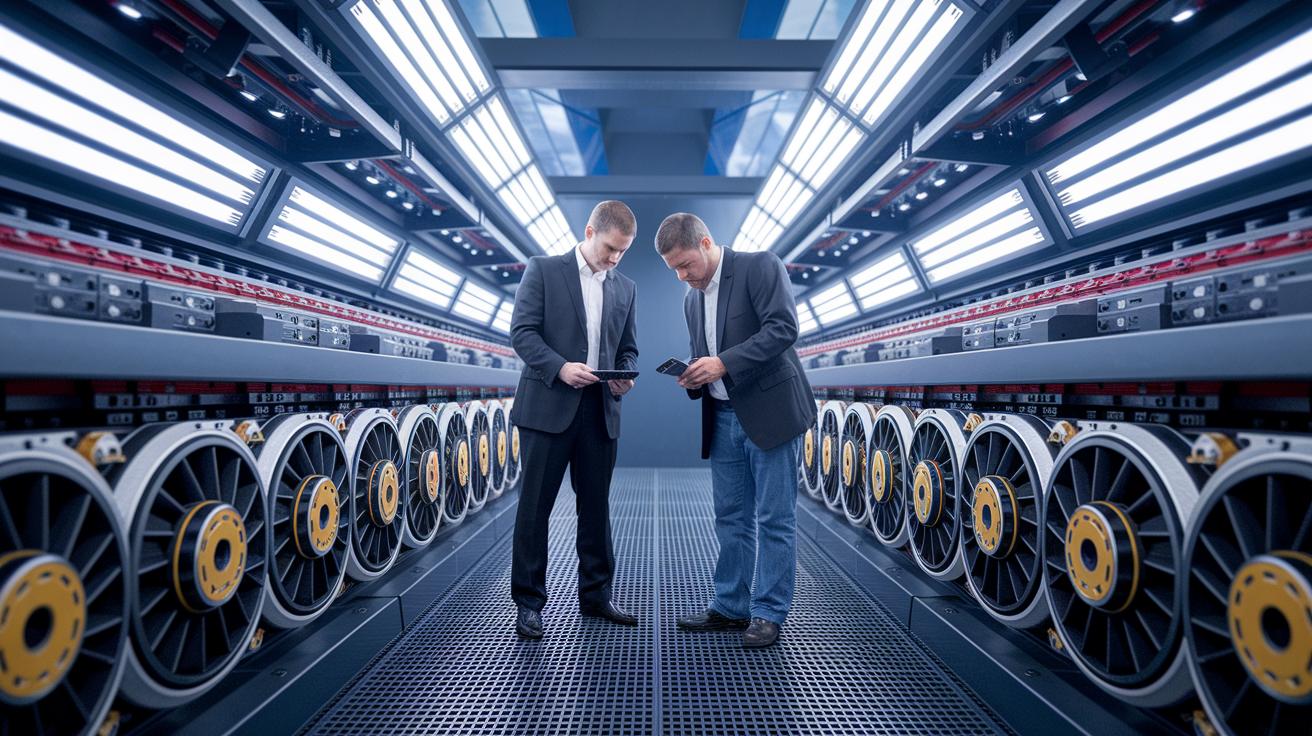
Marathon Digital Holdings is expanding quickly in North America. They’re investing a lot in specialized mining hardware (advanced ASIC technology, which is built for high-performance computing) to really boost their output.
CleanSpark Inc. mixes renewable energy with its mining work to lower its carbon footprint. They focus on keeping operations green while staying efficient.
HIVE Digital Technologies is growing smartly by using new, innovative methods. They build scalable mining setups that also help minimize environmental impact.
Riot Blockchain uses top-notch equipment at its Texas sites. Their goal is a 1 GW capacity build-out, which lets them make the most of power credits.
Core Scientific runs state-of-the-art mining farms backed by strong research. They lean on cutting-edge technology to keep their hash rate performance high, ensuring competitive strength.
Iris Energy (IREN) offers scalable mining powered mainly by renewable energy. They’re committed to growth that keeps their carbon footprint low.
TeraWulf Inc. combines energy-efficient practices and clean power sources. Their focus on operational precision helps maintain strong capacity.
Cipher Mining Inc. is the new kid on the block with strong financial support. Their use of modern rigs gives them a competitive edge in the market.
Bitdeer Technologies Group provides complete hosting and cloud mining services. Their all-in-one approach makes it easier to keep operations running smoothly.
Bitfarms Ltd. operates an international network that brings stability. By balancing geographic factors, they boost operational resilience.
For more on how to structure your mining investments, check out the guide on investment portfolio management at https://cipherreview.com?p=407.
Regional Overview of U.S. Bitcoin Mining Hotspots
Texas leads the pack. It houses almost half of the total 5.42 GW capacity, with heavyweights like Riot’s 700 MW Rockdale facility and Marathon’s 300 MW Granbury site in the mix. This setup not only supports massive mining operations but also benefits from friendly rules and low electricity bills.
Core Scientific is spreading its wings across Texas, Georgia, and North Dakota. Their goal? To hit a hash rate of 40–42 EH/s by late 2024. This multi-state stretch shows how different rules in each state can offer unique perks to mining operations.
Georgia is quickly becoming an important mining center. The state is home to facilities from both Core Scientific and CleanSpark; the latter runs eight out of its eighteen operations, aiming to surpass 21 EH/s. Bitdeer also taps into Georgia’s low-cost power through its cloud and rental services.
New York adds its own flavor to the scene. Notable projects include Coinmint’s 435 MW transformer capacity in Massena and Bit Digital Mining, which is on track to hit 6.0 EH/s by 2024.
- Friendly regulations and affordable power boost each state’s mining performance.
- Different regional setups give miners special competitive edges.
Key Metrics and Evaluation Criteria for Bitcoin Mining Firms
When people look at bitcoin mining companies, they check both the figures and the strategies behind the business. Profit can depend on factors like bitcoin price swings, network difficulty (how hard it is to solve a block), energy costs, and hardware efficiency. Take energy use per terahash (terahash means the energy, in joules, needed to perform a trillion calculations) for example, a lower number here can really boost profits on each mined bitcoin.
Basic financial indicators like revenue, gross margin, and operating expenses offer a snapshot of a company’s health. Then there are mining-specific numbers such as the hash rate measured in exahashes per second (EH/s, meaning a trillion trillion calculations per second), which show how powerful a mining operation is. I once read about a mine that slashed its energy use by 15% in a single quarter using the latest ASIC technology, and that small change drove up its profit margins in a big way!
The choice of hardware also plays a crucial role. Big names like Bitmain, MicroBT, and Canaan set high standards with their specialized machines built for fast, efficient calculations. So, when you’re evaluating a mining firm, it’s important to see if they’re using up-to-date equipment that helps keep power costs down while boosting output.
Don’t forget the business model, either. Investors often compare self-mining, hosting, and cloud services to see which one fits best. Self-mining gives you total control and might offer higher returns, while cloud services can save you the headache of managing all that hardware. Isn’t it interesting how each model caters to different needs?
In the end, mixing both hard data and smart strategy gives you the full picture of a mining firm’s potential. It all comes down to balancing standard financial numbers with mining-specific details to make well-informed decisions in bitcoin mining.
Emerging Trends and Future Outlook for Bitcoin Mining Companies
Data centers are now switching lanes to manage AI tasks, and that change is opening up fresh ways to earn money. Companies are using their energy-smart setups to handle the heavy computing needed for AI, which not only boosts mining but also powers new digital services. Imagine a mining facility that cuts down on wasted time by using its extra computing power for AI work. One miner even shared that this switch bumped up their other revenue by 20%.
Cloud mining is also on the move. Services like Binance Cloud Mining offer 1 TH/s for $23.04 over 90 days, while others like Hashmart and Hashing24 provide various contract options, from fixed terms to longer 12-to-24–month deals. This means investors can start mining without ever having to deal with the hassle of managing physical hardware.
New contract ideas are coming into play too. For example, ECOS offers contracts that change in length and expected rewards to match different investment plans. Plus, tools like Awesome Miner support more than 50 mining programs in one place, making management a lot simpler.
Other cool tech upgrades include immersion cooling and smart grid integration, both of which help cut energy costs and boost overall efficiency. Partnerships with renewable energy sources are also on the rise, pointing the way to greener digital mining processes.
- Shifting data centers to AI tasks
- Expanding cloud-based mining options
- Using better cooling and smart grid tech
These innovations are setting the stage for a future where mining companies transform from simple coin extractors into versatile digital service hubs.
Final Words
In the action of reviewing the ranked overview of bitcoin mining companies, we explored key performance figures, regional insights, and evaluation criteria that shape today’s mining landscape. We broke down notable achievers like Marathon Digital Holdings and Cipher Mining, alongside emerging trends such as AI workloads and renewable energy sources.
This post offers a clear look at the dynamic market for the top bitcoin mining companies. Keep moving forward with confidence and stay curious about each new milestone ahead.


